

Marble
Marble is the metamorphic equivalent of limestone. which is produced by recrystallization and is hard enough to take a polish. It is found in various colours. It contains dominantly calcite and subordinately dolomite, iron oxide, graphite, and some quartz.
The hardest and most attractive marbles have been used in statuary and for building since antiquity and are still quarried, e.g. from the Carrara quarry which supplied Michelangelo.
The statue of Abraham Lincoln at the Lincoln Memorial, Washington, DC, is made from marble quarried in Georgia, USA. Marbles may be variously coloured or banded, depending on their chemical and min- eralogical composition
marble is composed principally of densely packed calcite but can have all kinds of appearances. Marble is meta-morphosed limestone, so just as that rock is rarely pure, so marble typically contains various minerals besides calcite, which gives it a multitude of colors and patterns. Even Carrara marble has blue-gray smudges and patches, owing to original organic carbon.
Quarries for this world-famous marble dot the hillsides above the Carrara Massa wine district and over on the other side of the Alpi Apuane. Michelangelo spent many anguished times around Carrara. Once he narrowly missed death as a chain snapped. Now it turns out that his David, prob- ably the most famous sculpture of all, is actually a somewhat inferior marble, full of microscopic holes that are presenting challenges to those conserving the work today.
However, marble is not common in the world’s vineyards, and it’s not a widespread rock anyway. In fact, geologically speaking, much of what is called marble is actually limestone that can be polished, which is the meaning of “marble” in the decorative stone trade.
So if you encounter “marble” in vineyard regions, it may actually be limestone. You can usually tell from the other rocks that are around, especially if they contain fossils, which are common in limestone but not in marble, having been obliterated during metamorphism.
Near Swallenbach, in the Wachau, Austria, the marble in the vineyards wholly lacks fossils and is hemmed in by distinctly metamorphic rocks such as gneiss. So it’s a true metamorphic marble. On the other hand, the “Comblanchien marble” that caps the skyline in parts of the Côte d’Or, France, is just one layer in a sequence of fossil-bearing sedimentary strata. It’s an attractive, polishable stone, used, for example in the Basilica of St. Denis in Paris, but it’s a sedimentary limestone.
The Dalmation island of Brač is famous for its “marble.” Away from the quarries, patches of vines are planted in depressions in the rock for wind protection. which is augmented by walls and heaps made from the white loose stones that lie all around. Although the rock is compact and polishes well, some parts are packed with delicate fossils. So although it’s widely called marble, geologically it’s a limestone.
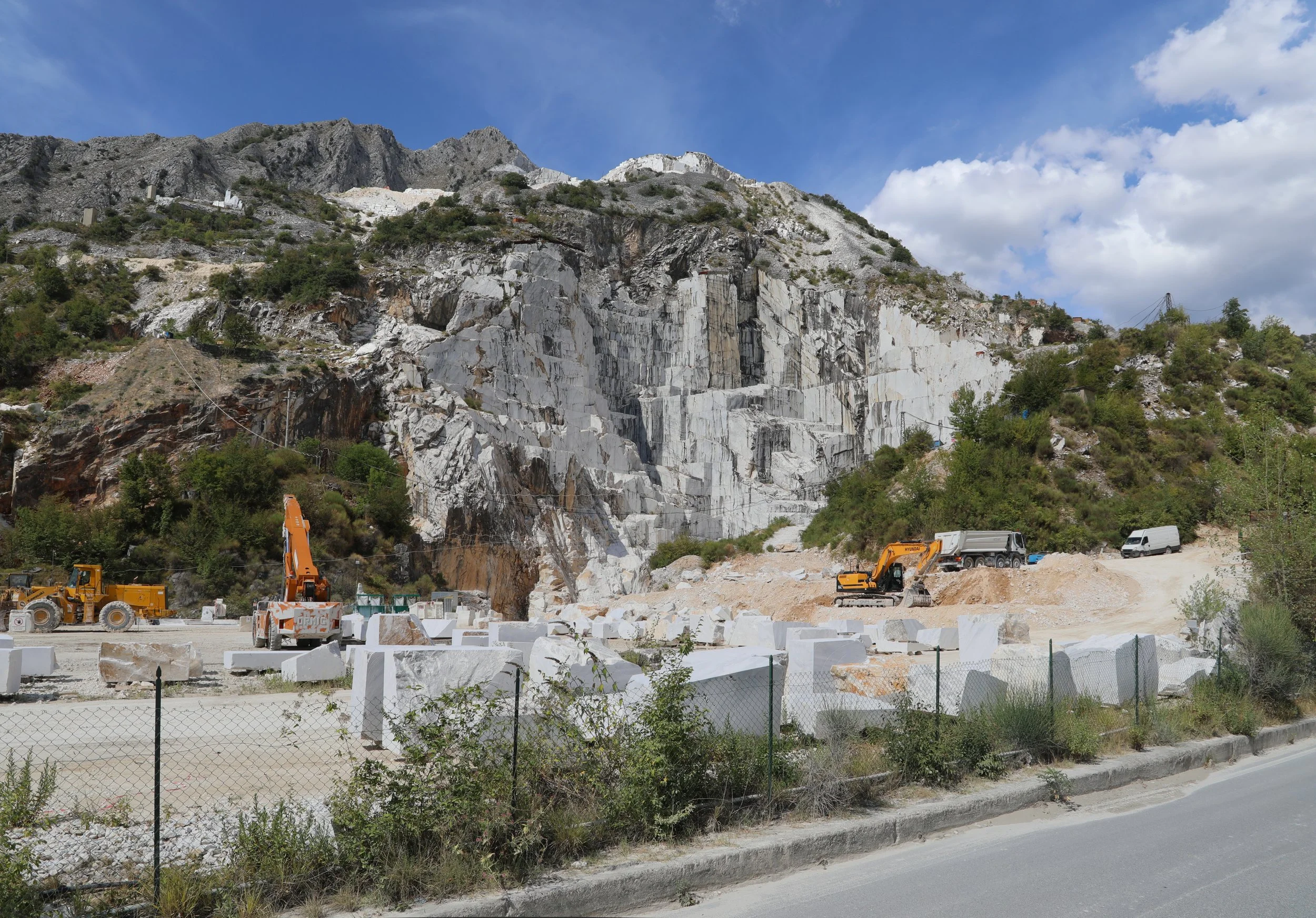
One of the most famous sources of marble is from Carrara, ~100 km west-northwest of Florence, Italy. This is where Michelangelo spent considerable time looking for just the right piece of marble for his next statue
When metamorphosed, limestone turns into marble, which can be a beautiful decorative stone. Recrystallization of calcium carbonate usually gives it a bright white colour, and any impurities tend to concentrate into colourful veins.